Why it matters
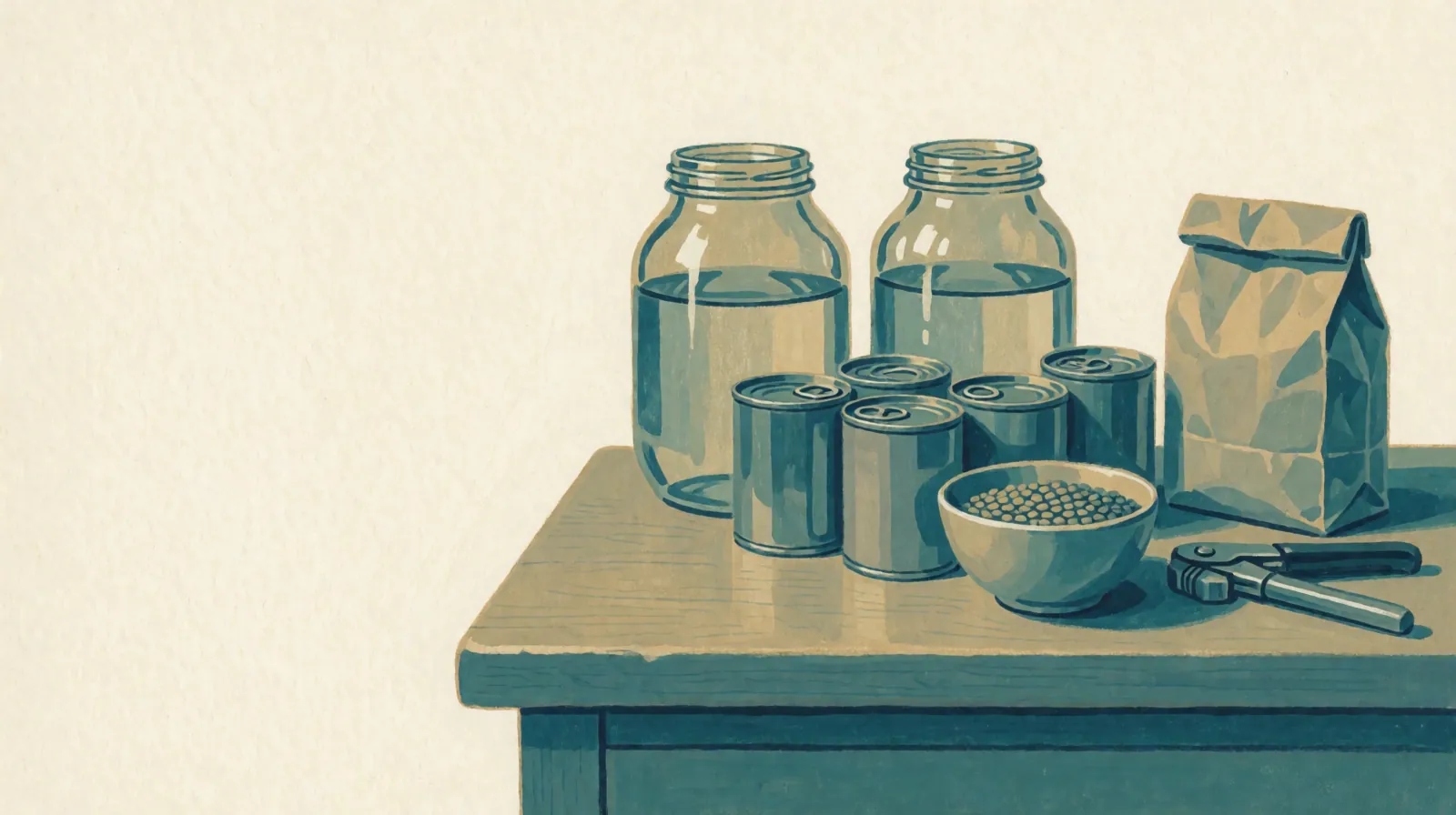
Water runs out first. Be ready to look after your household for at least 72 hours.• Water and food are where that starts.
The good news: it doesn’t take much. A few cases of water and a shelf of food you can eat without cooking go a long way, and you can build them up a little at a time.
What the guidance says
The first few days
Water
Store water before you need it. Plan on 4 litres per person, per day, for drinking, cooking and some washing. For a family of four, three days is 48 litres.
- Buy it by the case, with some smaller bottles that are easier to carry.
- Or fill your own. Use clean, food-grade containers, never one that held chemicals, and skip milk jugs. Fill them with tap water, close them tight and date each one. Replace water you bottled yourself every six months.•
- Keep it clean and cool, like a basement, away from cleaning products and out of direct sunlight.
- Keep a little extra for wudu. Go by what your household uses. If water ever runs short, Surah al-Ma’idah 5:6• describes tayammum (dry ablution, with clean earth). More on that in the faith guide.
Food
Keep at least three days of food that won’t spoil, and a manual can opener.• For the first few days, choose food that needs no cooking and little or no water.
| Food | Ready to eat? | Good to know |
|---|---|---|
| Canned beans and lentils | Yes | Rinse them if you can spare the water |
| Canned fish | Yes | Pick pull-tab tins, or keep the opener with them |
| Energy bars | Yes | Check the label for gelatin |
| Dates, dried fruit and nuts | Yes | Check for nut allergies |
| Nut butter and crackers | Yes | The same allergy check applies |
| Ready-to-eat meal kits | Yes | Look for halal certification |
| Rice, pasta and flour | No | Need water and heat. Keep for later |
- Check every can. Never eat canned food that is dented, leaking or has bulging ends.
- Watch for gelatin. It’s commonly made from pigs and cattle, and turns up in marshmallows, sweets and some yogurts.• If a snack contains it, look for a halal certification you trust.
- Ready-to-eat meal kits (MREs) are full meals in a pouch. Look for a halal certification you trust, or choose a vegetarian kit.
- Infant formula carries an expiration date, not a best-before date. Once it has passed, throw it out. If you make up formula with water, use boiled water, every time.
Over the coming months
Make water safe to drink
If your tap water isn’t safe, or your stored water runs low, you can make more. Your local authorities will tell you whether tap water is safe to use. Keep water purifying tablets in your kit for when you can’t boil.•
- Boil it. Bring it to a rolling boil, where the bubbles keep coming even when you stir, and hold it there for at least 1 minute. Above 2,000 metres, boil it for at least 2 minutes.
- If boiling isn’t practical, use purification tablets. Follow the label.
During a boil-water advisory
Use safe water for anything you swallow during a boil-water advisory•:
| Use safe water for | Tap water is still fine for |
|---|---|
| Drinking, drinks and ice | Dishes and laundry |
| Cooking and baby formula | Washing hands with soap for at least 20 seconds |
| Washing fruit and vegetables | Bathing, as long as you don’t swallow it |
| Brushing teeth | (Sponge-bathe babies and toddlers instead) |
Your local advisory has the final word.
After a power outage
Keep the fridge and freezer doors closed.• Food stays cold for about:
| Where | How long |
|---|---|
| Fridge | 4 hours |
| Full freezer | 48 hours |
| Half-full freezer | 24 hours |
Then:
- Refreeze only what’s still cold. Ice crystals, or fridge-cold to the touch.
- Throw out food that sat at room temperature for 2 hours or more.
- Don’t trust smell or looks. Food with bacteria doesn’t always smell bad or look spoiled.
- Never taste food to check it.•
- Don’t put frozen food outside, even in winter. The sun can thaw it on a very cold day.
The short version: keep the doors shut, and when in doubt, throw it out.
Build a deeper pantry
Stock the staples you already cook with, so nothing goes to waste. Sealed, in a cool, dry pantry, they keep for about:
| Staple | Keeps for about | Good to know |
|---|---|---|
| White rice, dried beans | 1 year | Brown rice: only 6 months |
| White flour | 10 to 15 months | Whole wheat: 3 months |
| Vegetable oil, honey | 1 year | Olive oil: 6 months |
| Nonfat dry milk | 1 year | Keep it sealed and dry |
| Spices | 2 to 3 years | Whole spices: 4 to 5 years |
| Salt, white sugar | Indefinitely | Keep them dry |
- Keep it cool and dry, away from the stove, hot water pipes and heating ducts.•
- Use airtight containers of glass, metal or rigid plastic.
- First in, first out. New stock goes to the back, and you use the oldest first.
- Check for halal. Beef and chicken bouillon cubes and stock powders are made from meat, so look for a halal certification. Lard is pork fat: choose ghee or vegetable oil.
Rotate what you store
- Date everything on the lid.
- Replace stored water after one year, even if the bottle says two.• Water you bottled yourself: every six months.
- Replace kit food once a year.• Eat it before it goes, and restock.
- Check twice a year.
- Know your dates. A best-before date is about quality, not safety. An expiration date, on infant formula or meal replacements, means throw it out.
For the long term
These are projects, not purchases. Start one when you have a free weekend. The workbook has the full steps for each.
-
Grow some food. Salad greens, beans, peas, herbs and tomatoes all grow well in containers.• Herbs grow indoors too, with about eight hours of light a day from a sunny window or a grow light•.
-
Collect rainwater for the garden. Use it for the garden only: no Canadian guide covers making rainwater safe to drink.
-
Preserve food safely. Home canning has one serious risk: botulism, which doesn’t change how food looks, smells or tastes.• The safe rules:
- Use only current, tested home canning recipes. Don’t change jar sizes or amounts.
- Use a pressure canner for low-acid foods: meat, most vegetables, and mixed dishes like meat sauce.
- Use home-canned food within a year, and keep it somewhere cool and dry.
If you suspect botulism, see a health care professional and contact your local public health unit as soon as possible.
-
Pack dry food for long storage in Mylar bags with oxygen absorbers, or with a vacuum sealer.• Only pack food with about 10 percent moisture or less, like white rice, dry beans and white sugar: botulism can grow when moist food is sealed without oxygen.• Vacuum sealing doesn’t make food shelf-stable: meat, fish and other perishable food still go in the fridge or freezer.•
Do this now
You don’t need a full pantry to begin. Start with water. A case this week is a good first step.
Sources (18)
- Emergency kit checklist, Government of Canada
- Emergency kits, Government of Canada
- Be prepared for an emergency, Government of Ontario
- Food and drinking water safety in an emergency, Health Canada
- Guidance for issuing and rescinding boil water advisories in Canadian drinking water supplies, Health Canada
- Frequently asked questions about bottled water, Health Canada
- Home canning safety, Health Canada
- Best before, expiration and more: understanding the date labels on your food, Canadian Food Inspection Agency
- Power failure and food safety, City of Toronto
- Get Growing Toronto, City of Toronto
- Emergency water storage, Alberta Health Services
- Growing herbs indoors, Iowa State University Extension
- Food storage: pantry, Clemson Cooperative Extension
- Vacuum packaging foods at home, Clemson Cooperative Extension
- Food storage: will I use it?, Utah State University Extension
- Packaging foods, Utah State University Extension
- Gelatin traceability: from slaughterhouse to capsule, IFANCA
- Surah al-Ma’idah 5:6 (wudu and tayammum), Quran.com