Why it matters
When the power goes out, the lights, the heat and the chargers go with it. A few simple supplies keep everyone comfortable through most outages.
And a few firm rules about cooking and heating, kept every time, keep everyone safe.
What the guidance says
The first few days
Light and news
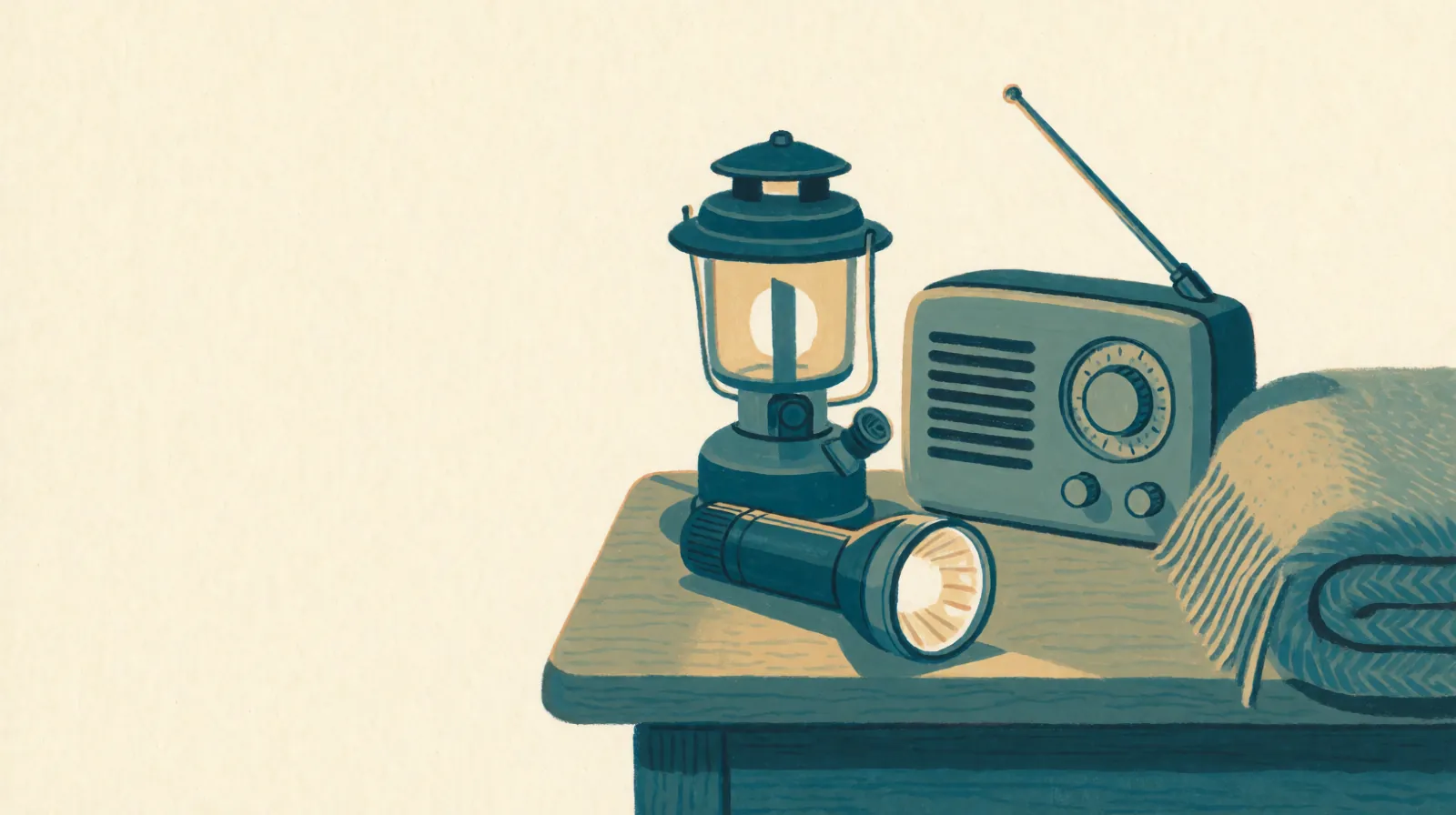
- Keep a flashlight and a radio, wind-up or battery-powered, with extra batteries, where you can find them in the dark.
- Add a headlamp for jobs that need both hands.•
- Use flashlights, not candles. If you do use candles, put them in a secure holder with a glass chimney, away from children and pets.
- Keep one flashlight in the washroom. It helps with wudu: Fajr and Isha both fall in the dark.
- Keep a printed prayer timetable from your masjid with your kit, so prayer times don’t depend on a phone you’re trying to save. More on that in the faith guide.
Phones and charging
- Keep a power bank charged. Top it up, and your phones, before a big storm.
- Save your battery if you can’t charge: turn on power-saving settings, and use the phone only when you need it.
- Consider a phone with a cord, just for emergencies. A cordless home phone or a mobile may not work if the power or the cellular network is down.•
- Keep your car’s tank at least half full, or your electric vehicle charged, if there’s a risk of an outage.
Alarms
Have working smoke and carbon monoxide alarms with battery backups. Alarms wired into the house won’t work when the power is out.
- Test them every month with the test button.
- Put in new batteries every year.
For where alarms must go, follow your province’s rules and your local fire department’s guidance.
When the power goes out
First, check whether it’s just your home. Look at your electrical panel and ask a neighbour, then report the outage to your utility. Never touch the panel with wet hands or while standing on a damp floor.
Find your electrical panel and water shut-off now, in daylight, and write down where they are.
Then follow this routine.•
- Unplug tools, appliances and electronics. For a short outage, you can leave the fridge and freezer plugged in. If it runs long, unplug them too.
- Turn the thermostat down, to prevent damage from a power surge when the power comes back.
- Leave one light on, so you know when the power is back.
- Keep the fridge and freezer closed. The water and food guide says how long food keeps.
- Stay at least 10 metres from downed power lines, and keep children and pets back too. Report them.•
- Drive only if you need to. Traffic lights may be out.
- Live up high? Plan a way out that doesn’t need the elevator, and tell building management if someone at home would need help.
When the power comes back:
- Make sure the hot water tank is full before its power goes back on.
- Turn the heat up first, then plug the fridge and freezer back in if you unplugged them.
- Wait 10 to 15 minutes before plugging in anything else.
Staying warm
- Keep a sleeping bag or warm blanket for each person.
- Dress in layers for a Canadian winter: a parka, insulated mittens, a hat that covers your ears, and a windproof, waterproof outer layer.
- A natural gas fireplace can keep you warm. A gas stove can still cook food, but never use a stove or oven to heat your home.
- Use only space heaters made for indoor use.
- Learn how to shut off your water and drain your plumbing. Pipes can freeze in a winter outage.
- Too cold to stay? If it’s safe to leave, go somewhere warm until it’s safe to come back.
You don’t need all of this at once. A blanket and a warm layer for each person is a good start.
Staying cool
- Close curtains or blinds during the day, and open windows at night for a cross-breeze, if you can.
- Drink water before you feel thirsty.
- Fans may not be enough to cool someone down. If home gets too hot and it’s safe to leave, find a cooling centre near you.
- Know heat stroke: headache, dizziness, confusion, fainting and a high body temperature. It’s a medical emergency. Get emergency help, and cool the person down right away.
- Check on people at higher risk: babies and young children, anyone pregnant, older adults, and anyone who lives alone.•
A call to an older relative or neighbour on a hot day is part of looking after each other.
Over the coming months
Safe cooking and heat
A long outage tempts people to cook and heat in unsafe ways. These rules hold every time.
- Never use a barbecue, camp stove or portable burner indoors. That includes the garage, shed, crawlspace and basement, even with the windows and doors open. Fuel-burning equipment gives off carbon monoxide, a gas you can’t see or smell.
- Never idle a car in a garage, even with the garage door open. That includes charging your phone or warming up in it.
- Keep space heaters at least 1 metre from anything that can burn. Before refuelling a fuel heater, turn it off, let it cool and take it outside.
- Fireplaces and wood stoves: open the flue first, burn dry, well-seasoned wood, and use a fire screen. Let ashes cool, then empty them into a metal container with a tight-fitting lid, kept outside.
- Have your chimney, furnace and fuel-burning appliances checked every year, before the cold weather.
If a carbon monoxide alarm sounds, get everyone out into fresh air and call 9-1-1 from outside. Don’t go back in until a qualified professional tells you it’s safe.
In a condo or apartment, check your building’s rules before you buy a barbecue, camp stove or generator.
For the long term
Backup power is a project, not a first purchase. The workbook goes deeper.
- A battery or solar power station keeps a few things running. Battery and solar generators make no carbon monoxide and can be used anywhere.•
- Start small with solar: lanterns, phone chargers and radios that charge in daylight. Winter days are short, so keep batteries too.
- A fuel generator gives more power, with strict rules. Check your local bylaws, fire code and building rules before you buy one, and get a licensed electrician’s advice before you install it.
If you use a fuel generator:
- Never run it indoors, or in a garage or shed.
- Keep it at least 6 metres from any home or building, with the exhaust pointed away from windows and doors.
- Plug appliances straight into it, with CSA-approved extension cords. Never plug a generator into a wall outlet.
- Connect it to your home’s wiring only through an approved transfer panel, installed by a qualified electrician.
- Choose a model that shuts off by itself when carbon monoxide levels get high.
- Let it cool before refuelling, and refuel it outside.
Do this now
You don’t need a generator to begin. Start with a flashlight and a charged power bank.
Sources (11)
- Power outages: get prepared, Government of Canada
- Emergency kits, Government of Canada
- Emergency kit checklist, Government of Canada
- Infographic: Carbon monoxide, Health Canada
- Carbon monoxide: overview, Health Canada
- Carbon monoxide safety, Government of Ontario
- Fire safety at home, Government of Ontario
- Power outages and blackouts, Government of Ontario
- Winter storms, Government of Ontario
- Extreme heat, Government of Ontario
- Be prepared for an emergency, Government of Ontario