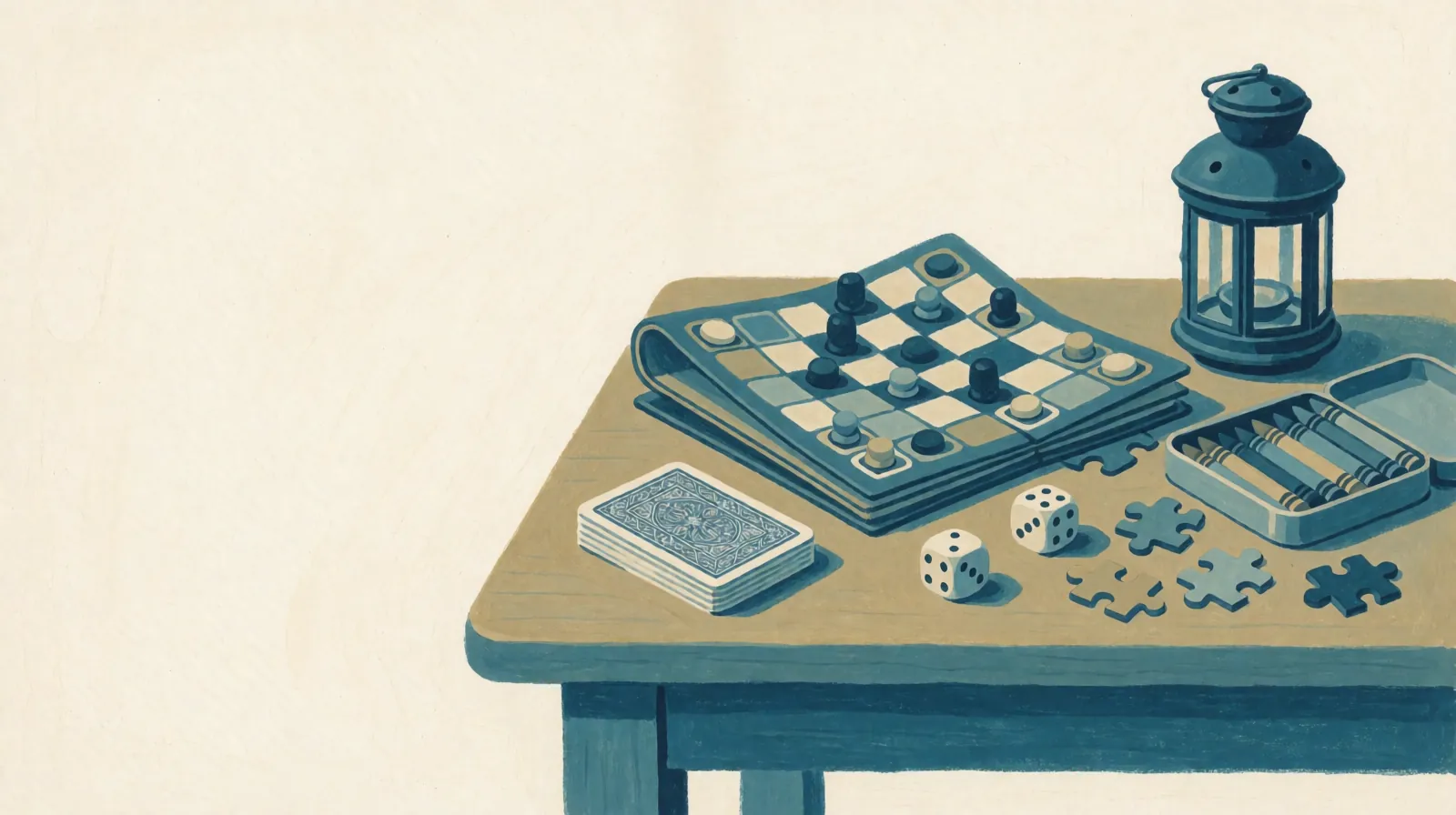
Why it helps
In an outage, your phone’s battery is for maps, alerts and check-ins, not for passing the time. Screen-free games, reading and conversation save it for when you need it, and fill long hours calmly for everyone, from children to elders.•
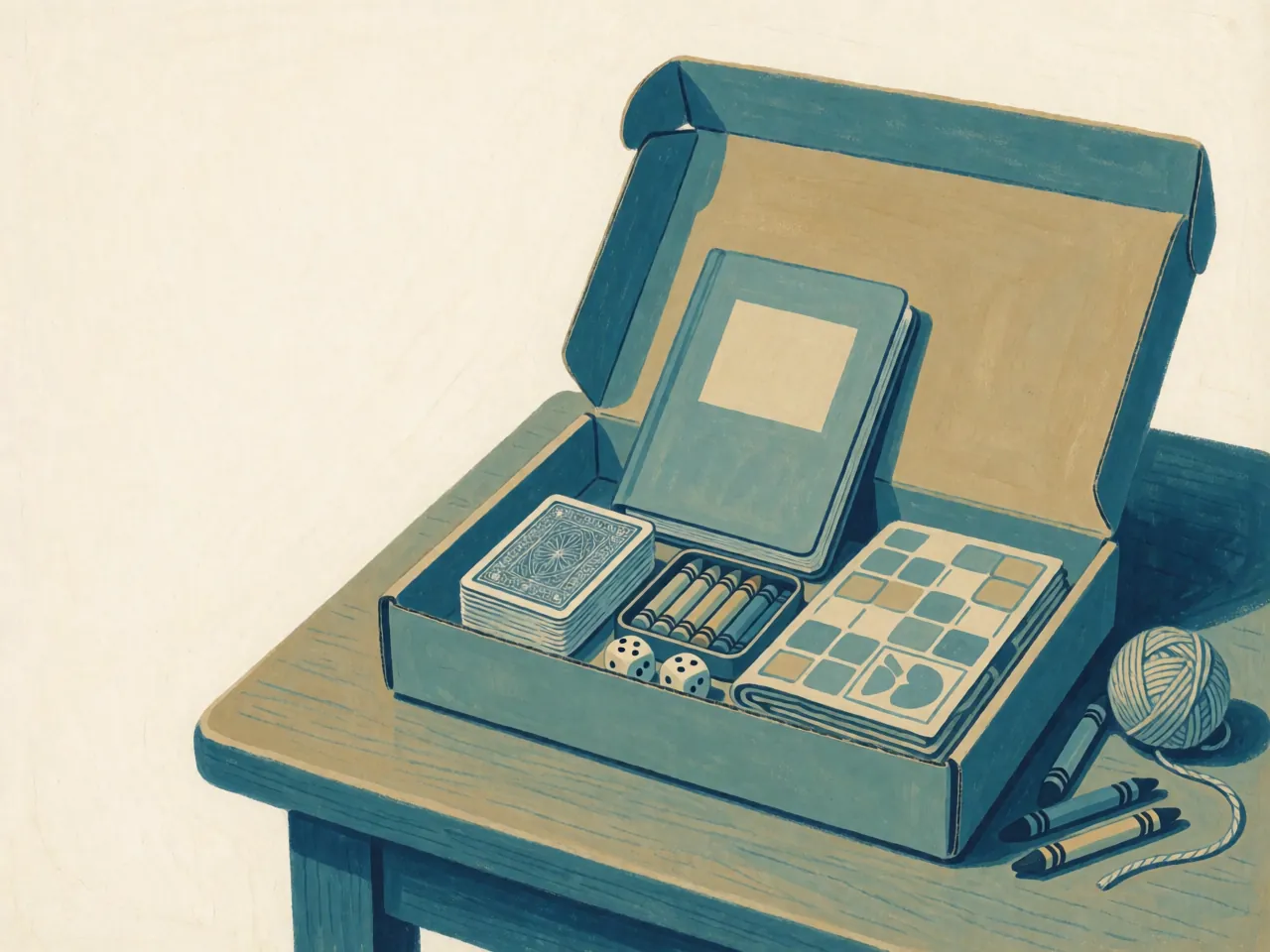
What to pack and download ahead of time
Keep a small container or drawer (your household’s boredom box) with items for your household.•
- Books & puzzle books: An unread novel or history, plus crosswords, Sudoku or word searches. Picture books for young kids.
- Cards & board games: One or two standard 52-card decks, dice, and a favourite tabletop game (chess, checkers, dominoes).
- Paper & drawing: A pad of plain or grid paper, pens, pencils with erasers, and coloured pencils or markers.
- Hands-on items: A jigsaw puzzle, craft or knitting project, or origami paper. Keep a battery lantern or glow sticks with your games; never use candles for play.
Download while you’re connected:
- Free e-books: Kiwix stores over 70,000 free classic books on your device.
- Library audiobooks and e-books: borrow a few in your library app before bad weather.
- Audio stories and podcasts. Audio with the screen off uses very little battery.
Card games
Each needs only a standard 52-card deck.
Crazy Eights (2 to 5 players)
A race to get rid of all your cards by matching the card on top of the pile.
- Setup: Deal 7 cards each for two players, or 5 each for three or more. Turn the top card of the rest face up to start the discard pile.
- On your turn: Play one card that matches the top card in suit or rank. Eights are wild: play one any time and name the next suit.
- Can’t play? Draw until you can, or until the pile runs out. First to play their last card wins.
Go Fish (2 to 6 players)
Collect sets of four by asking the other players.
- Setup: Deal 7 cards each for two or three players, or 5 each for four or more. Spread the rest face down: the pond.
- On your turn: Ask one player for a rank you hold. If they have it, they give you all of them and you ask again. If not, “Go fish”: draw one from the pond.
- Sets: Lay down each set of four. When all thirteen sets are made, the most sets wins.
Spoons (3 to 8 players)
A fast-paced table game. Place one fewer spoon (or marker or coin) in the centre than there are players.
- Setup: Deal 4 cards to each player.
- Passing: The dealer draws from the deck and passes discards rapidly to the left. Everyone picks up from the right and passes to the left, trying to collect four of a kind.
- Grab: As soon as someone gets four of a kind, they take a spoon.
- Scramble: Once any spoon is taken, everyone races to grab one of the remaining spoons. The person left without a spoon gets a letter in S-P-O-O-N.
The workbook adds Klondike solitaire for one player, and two card tricks.
Paper and table games (no board needed)
Categories (2 or more players)
- Draw 5 columns on paper with category headings (e.g. City/Country, Kitchen Item, Animal, Food, Job).
- Pick one letter and set a timer for 2 minutes.
- Everyone writes one word per column starting with that letter.
- Score 2 points for a unique answer nobody else has, and 1 point if someone shared your word.
The Three-Round Bowl Game (4 or more players, two teams)
- Everyone writes 3 nouns (people, places or objects) on slips of paper and drops them into a bowl.
- Teams take turns playing 60-second rounds with the same slips:
- Round 1 (Describe it): Use any words or sentences except the words on the slip.
- Round 2 (Act it out): Silent gestures and charades only.
- Round 3 (One word): Give exactly one clue word per slip.
Conversation and story prompts
Read these aloud when the room is dark or you want to save lantern battery:
Conversation questions:
- What is a meal from your childhood you still remember, and who made it?
- What is the most memorable storm, outage or trip you have lived through?
- What is a practical skill you learned from an older relative or neighbour that you still use?
- If you had a quiet week with no screens or errands, what would you make or learn?
- What is a small kindness from a stranger or neighbour you never forgot?
Round-robin story starters (each person adds one sentence):
- “The streetlamps went out at six o’clock, and that was when we noticed the lantern in the neighbour’s window…”
- “Inside the back of the hall closet sat a small wooden box nobody had opened since moving in…”
- “The train came to a gentle stop between two snowy forests, and the conductor brought out a thermos of tea…”
- “Every morning at sunrise, a ginger cat waited quietly on the steps of the old library…”
“Would You Rather” dilemmas:
- Would you rather spend a month in a cabin with 500 books and no internet, or on an island with internet and no books?
- Would you rather know how to repair every machine in your home, or speak every language in the world?
- Would you rather travel everywhere by train and bicycle, or everywhere by sailboat?
- Would you rather only be able to whisper for a week, or have to speak in rhyme for a day?
Solo, quiet and hands-on ideas
- Read or sketch: Read a paperback by lantern light, sketch your room from memory, or work on crosswords and Sudoku.
- Origami & paper planes: Fold paper airplanes for a hallway target contest, or fold a classic origami drinking cup.
- After dark: On a clear night, step outside and find the Big Dipper; its two outer bowl stars point to Polaris, the North Star.
Quick trivia starter (8 questions)
- Canada: Which two provinces have no saltwater coastline? (Alberta and Saskatchewan.)
- Science: Does warm or cold water freeze faster in open trays under certain conditions? (Warm water; called the Mpemba effect.)
- Plants: Which plant is the tallest kind of grass in the world? (Bamboo.)
- Nature: What is the only mammal capable of sustained flight? (The bat.)
- History of science: Who wrote the 11th-century Book of Optics after studying light through a pinhole camera? (Ibn al-Haytham.)
- Everyday maths: What do the numbers on opposite sides of a standard die add up to? (7.)
- Astronomy: Which star sits directly above Earth’s North Pole? (Polaris, the North Star.)
- Language: What common yellow fruit takes its English name from the Arabic word laymun? (The lemon.)
The workbook goes deeper with solitaire and card tricks, journal prompts, a 16-question trivia night, Outage bingo, printable puzzles and colouring pages, and a star chart.
Do this now
Put a deck of cards, a pad of paper, two pens and an unread book into a bin or drawer near your supplies. That five-minute step gets your household ready for a quiet evening.
Sources (3)
- Prepare children for emergencies: tips for parents and caregivers, Government of Canada
- Emergency kit checklist, Government of Canada
- Download Kiwix applications and offline content packages, Kiwix