Why it matters
Small injuries don’t wait for the power to come back. And it may be hard to get prescription medications during an emergency, or for a while after it.
A stocked kit, a few weeks of medication and a written list cover most of what you will need. None of it takes long to put together.
What the guidance says
The first few days
First aid kit
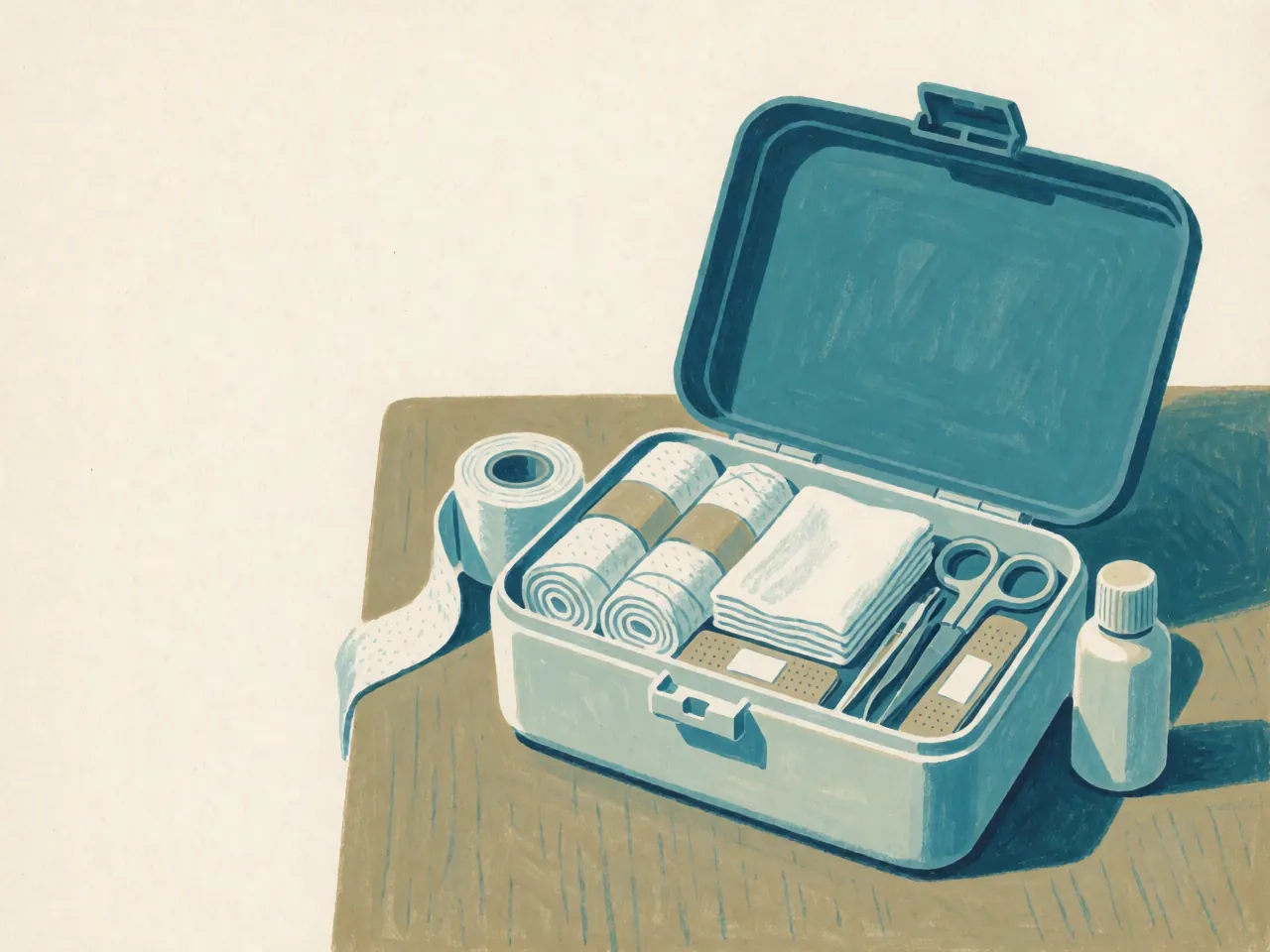
The basics: adhesive bandages and tape, gauze, antiseptic wound cleanser or wipes, disposable gloves, pain relievers, and face masks (N95 or surgical).•
- Keep it with your home kit, where adults can find it and small children can’t reach it.
- Restock as you go. Whenever you use something, replace it.
- A ready-made kit is a fine start. Add what you use most.
- Round out the pain relief with a muscle-pain gel or cream, and instant hot and cold packs. Follow the label.
Medications
If you can, keep enough medication to last a couple of weeks.• Your pharmacist can tell you what’s possible for each prescription.
Keep a grab-and-go medication bag with the essentials.•
-
Medications: prescriptions (pills, eye drops, creams), emergency ones like an EpiPen or inhaler, and nonprescription ones like pain relievers and antacids.
-
Medical supplies: a glucometer, test strips, syringes, extra batteries.
-
Papers: your medication list, copies of prescriptions, ID and your health card.
-
What someone can’t manage without: eyeglasses or contacts, hearing aids, dentures or a walker.
-
Hygiene supplies and a small first aid kit.
-
Keep medications in their original containers, and never combine different ones in one bottle.
-
Carry the bag with you if you leave, not in luggage.
-
Gelatin capsules. Many capsules are made from gelatin, which is commonly made from pigs and cattle.• If that matters to you, ask your pharmacist whether another form is available. Never stop or swap a prescribed medication without asking your doctor or pharmacist first.
Your medication list
Write down every medication each person takes, prescription and nonprescription:
| For each medication | Example |
|---|---|
| What it’s for | Blood pressure |
| The dose | As written on the label |
| How often | Once a day, in the morning |
- Add allergies, to food and to medications.
- Add your doctor and pharmacy, with their phone numbers.
- Keep two copies: one in the grab-and-go bag, one with your documents. A photo on your phone is a handy third.
- Update it whenever a prescription changes.
Hygiene
Keep toiletries, menstrual supplies, toilet paper, hand sanitizer and garbage bags with your kit. Add a small bottle for istinja (washing after using the toilet), for when the water isn’t running.
When the toilet can’t flush
If the water is off or the sewer backs up, you can still use the toilet without flushing•:
- Turn off the toilet’s water valve, and flush once to empty the bowl.
- Line the bowl, under the seat, with two garbage bags, one inside the other. A bucket with a toilet seat works the same way.
- Add cat litter or a similar absorbent to the inner bag. Close the lid, or cover the bucket, between uses.
- When it’s full, tie the inner bag closed, put in a new one and add more litter.
- Keep used bags away from children, pets and wildlife, such as in a garbage can in the garage.
Wash your hands with soap and running water. If there’s none, use wet wipes and hand sanitizer.
Over the coming months
Refills and storage
A few habits keep your medications ready.•
- Know how much you have on hand, and order refills early if your usual pharmacy may be hard to reach.
- Check expiry dates regularly, and look at a medication before you take it.
- Protect medications from extreme heat and cold. Keep them in a cool, dry place, away from the sun.
- Keep a cooler and ice packs ready for medications that need the fridge, such as insulin.
- Use watertight containers if flooding or water damage is possible.
- Keep distilled or bottled water for any medication you mix with water.
If you can’t get your medications during an emergency, an evacuation or a pharmacy closure, any pharmacy near you can help you get an emergency supply.
Clear out once a year
Go through your medicine cabinet at least once a year.•
- Take out anything expired, or that nobody takes any more.
- Bring it to a pharmacy for disposal.
- Never flush medications or pour them down the sink.
Do it when you replace the medications in your kit. Replace them at least once a year.•
Medical devices and outages
If someone at home relies on a medical device that runs on electricity, or on refrigerated medicine, make a power outage plan for it:
- Talk to their doctor about what to do if the power goes.
- Keep a list of places nearby that provide that equipment or treatment.
- Consider a medical alert program, and check that it works without power.
- Think about backup power. The power guide covers power stations.
If someone at home has a disability or limited mobility, build a support network of at least three people you trust.• Show them how the equipment works, and label it with the owner’s name.
For the long term
Learn first aid
A kit is only as useful as the hands that use it.
- Take a course. St. John Ambulance runs family courses, including one on children’s injuries and a “Home Alone” course for children aged 10 and over.•
- Teach children age-appropriate first aid, and when to call 9-1-1: when someone is in immediate danger or needs urgent medical help.•
The workbook goes deeper.
Do this now
You don’t need a paramedic’s kit to begin. Start with the list.
Sources (12)
- Emergency kit checklist, Government of Canada
- Emergency kits, Government of Canada
- Power outages: get prepared, Government of Canada
- Emergency preparedness for persons with disabilities, Government of Canada
- Prepare children for emergencies: tips for parents and caregivers, Government of Canada
- Medication checklist for emergency preparedness, Canadian Pharmacists Association
- Essential items for an emergency kit, Canadian Red Cross
- Using medications safely, Health Canada
- Safe disposal of prescription drugs, Health Canada
- Family first aid, St. John Ambulance
- Gelatin traceability: from slaughterhouse to capsule, IFANCA
- Toilet use during an emergency, Washington State Department of Health